The Science of Imagination-Based Learning in Toddler Soccer | HappyFeet KC
The Science of Imagination-Based Learning in Toddler Soccer
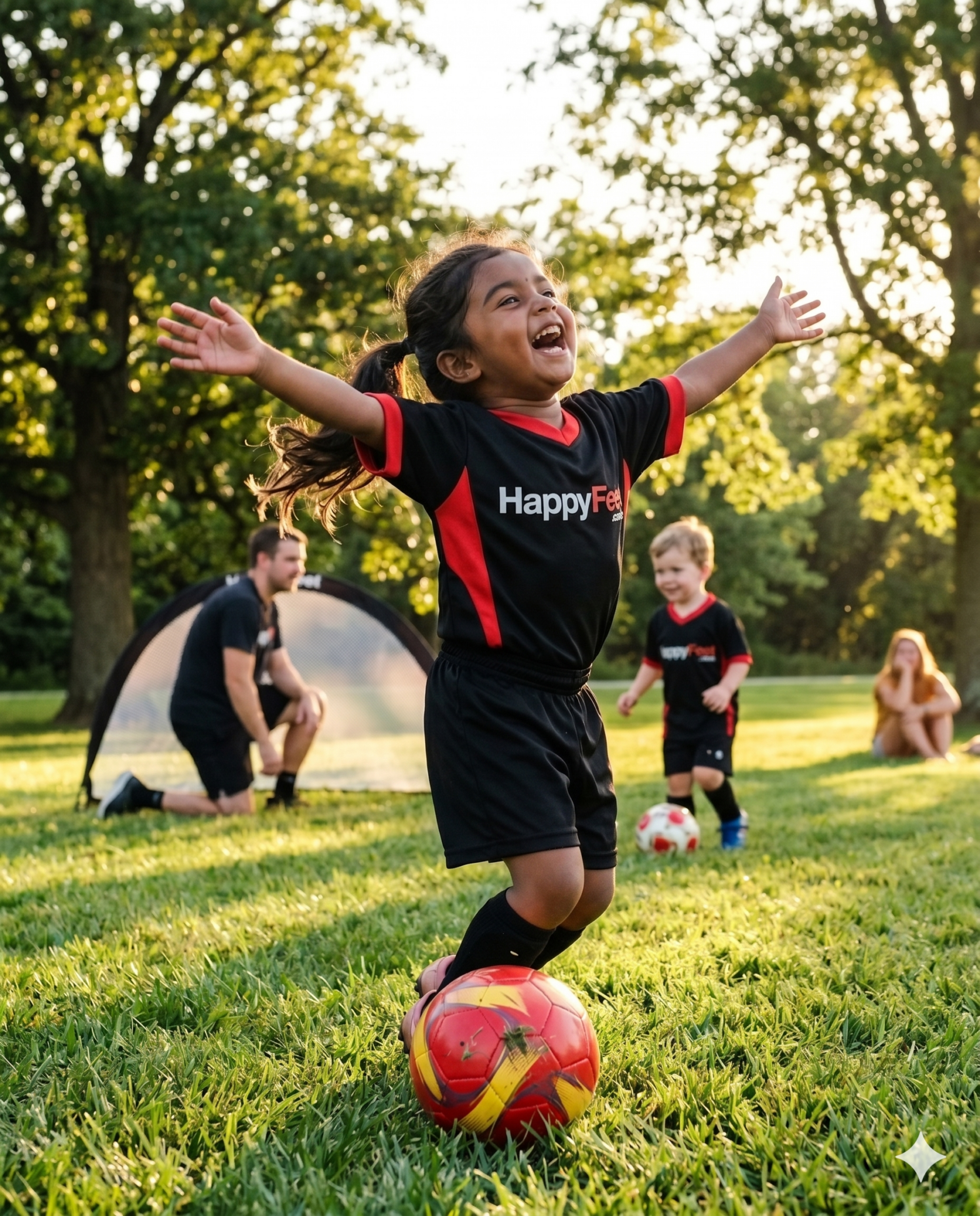
Imagination sparks every game — HappyFeet KC.Published January 10, 2025 • 5 min read
Traditional sports instruction often relies on repetitive drills and direct commands. But for toddlers, whose brains are wired for play and imagination, a different approach works far better. Imagination-based learning transforms soccer practice into an adventure, dramatically increasing engagement, retention, and skill development.
Why Imagination Supercharges Learning
When children engage in imaginative play, multiple brain regions activate simultaneously. This creates stronger neural connections than passive learning or rote repetition. The child who imagines they’re “taming a wild bobcat” (their soccer ball) is actually:
Processing the narrative (language centers)
Visualizing the scenario (visual cortex)
Executing motor skills (motor cortex)
Managing emotions (limbic system)
Problem-solving in real-time (prefrontal cortex)
“Pretend play has been shown to strengthen executive function, enhance self-regulation, and improve cognitive flexibility in young children.”
— Developmental Psychology Review, 2021
The Bob the Bobcat Method
HappyFeet’s curriculum centers on Bob the Bobcat, a character children learn to “tame” through soccer skills. This isn’t just cute branding—it’s applied developmental psychology:
🐱 Why Bob Works
Emotional connection: Children care about their “bobcat” ball
Narrative framework: Each session tells a story with beginning, middle, end
Intrinsic motivation: Kids want to practice because it’s fun, not because they’re told to
Repetition disguised as play: Same skills practiced without boredom
Songs and Movement Integration
Music activates the brain’s reward centers while synchronizing motor movement. When children sing about soccer skills, they:
Encode movements in long-term memory more effectively
Develop rhythm and timing essential for coordination
Reduce anxiety about trying new skills
Build social bonds with peers through shared experience
Traditional vs. Imagination-Based Approaches
Research consistently shows imagination-based methods outperform traditional instruction for young children:
❌ Traditional Drill-Based
Direct instruction: “Kick the ball this way”
Repetitive practice of isolated skills
External motivation (praise, rewards)
Often leads to boredom and disengagement
Skills may not transfer to real situations
✅ Imagination-Based
Story context: “Let’s help Bob escape!”
Skills embedded in engaging scenarios
Intrinsic motivation (fun, adventure)
High engagement and repeated practice
Natural skill transfer through play
“Children in play-based physical education programs demonstrated 40% greater skill retention compared to traditional instruction groups.”
— Journal of Early Childhood Education, 2020
The Long-Term Impact
Children who learn sports through imagination-based methods develop:
Positive associations with physical activity that last into adulthood
Creative problem-solving skills on and off the field
Self-confidence from mastering challenges in a supportive environment
Love of learning that transfers to academics and other domains
Resilience from experiencing failure as part of a fun adventure
What Parents Notice
Parents of children in imagination-based programs consistently report:
Children ask to practice at home (without being told)
Kids talk about their “bobcat ball” and class adventures
Improved attention span and ability to follow instructions
Greater willingness to try new physical activities
Social skills development from group storytelling experiences
See Imagination-Based Learning in Action
Watch your child fall in love with soccer through stories and adventures with Bob the Bobcat.
Try a Free Class
Experience It in Kansas City
HappyFeet KC brings imagination-based soccer to toddlers throughout the Kansas City metro. Our trained coaches guide children through adventures with Bob the Bobcat, building motor skills while creating lasting positive memories: