
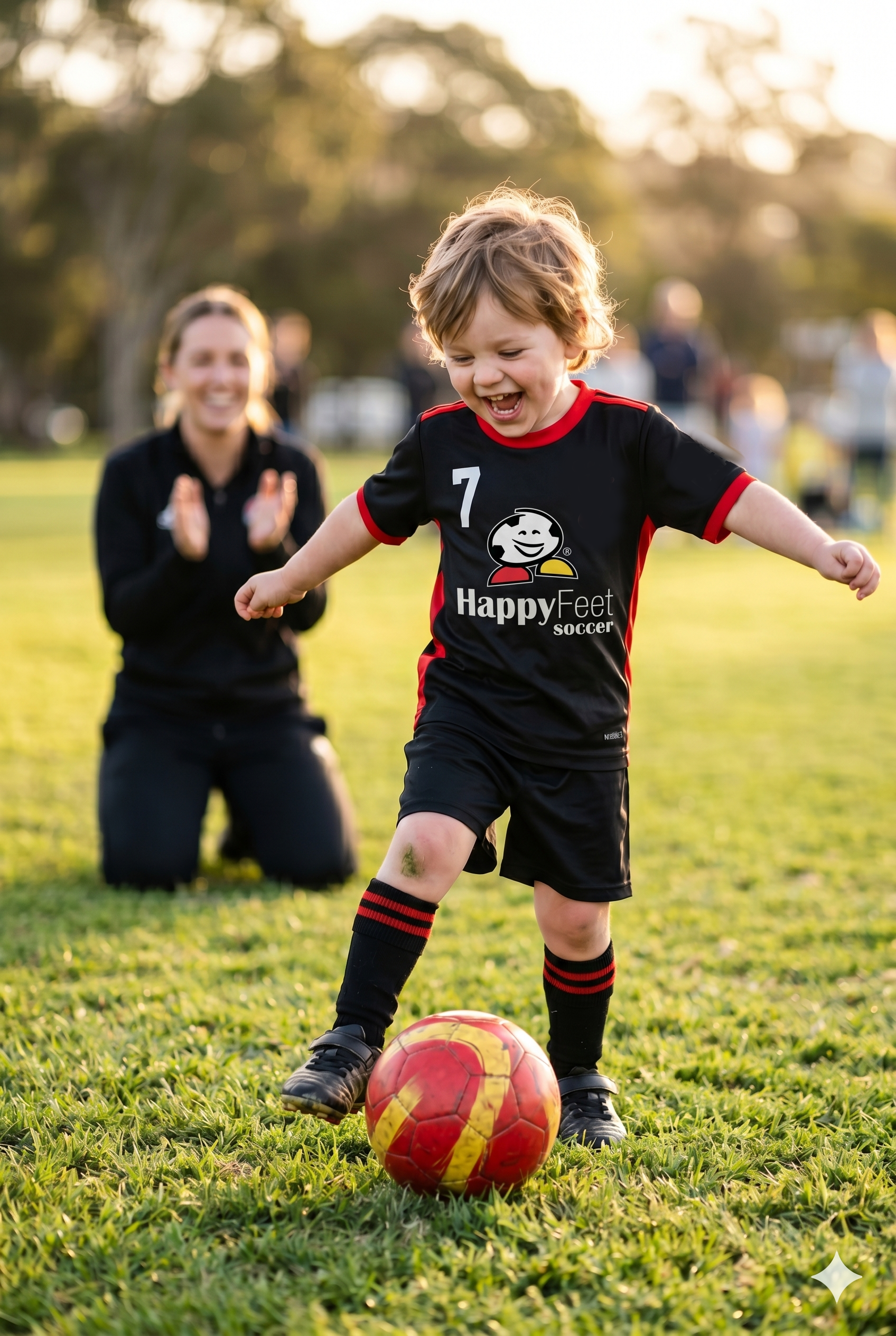
A child can start soccer as soon as they can walk confidently — typically around around age 2. But "soccer" at that age looks nothing like a game. It's 30–45 minutes of running, falling, kicking a ball, chasing a coach, and squealing. That's the point. The goal at ages 2–4 isn't skill development — it's falling in love with movement.
What they can do: Walk, run (sort of — it's more of a controlled fall), kick a stationary ball, pick up a ball and carry it, mimic animal movements.
What a class looks like: Parent-and-me format. 30 minutes max. Songs, stories, and very simple games. The ball is just one prop among many — most of the class is movement set to a story. The child may spend half the class just watching. That is normal and valuable.
Parent expectation check: Your child will not "learn soccer." They will learn that a ball is fun, that a coach is a safe adult, and that moving their body feels good. This is a win.
HappyFeet program: Parent & Me classes, 30 min. Parent participates alongside child.
What they can do: Run with more control, kick a rolling ball, stop a ball with their foot (sometimes), follow a 2-step instruction, take turns (with prompting), tell you an elaborate story about a soccer ball that is actually a dragon egg.
What a class looks like: 45 minutes. Story-driven games where the ball is a character — Bob the Bobcat needs help getting the ball past the Grumpy Crocodile. Lots of running, falling, getting back up. One ball per child. No lines, no drills, no waiting. Every child is moving the entire time.
Parent expectation check: Your child will come home tired and dirty. They may or may not be able to tell you what they did. They will ask when they get to go back. The 2-3 age range is the sweet spot for starting — old enough to participate, young enough that imagination-based learning still feels like magic.
HappyFeet program: Core program, 45 min. Independent (parent watches or drops off). Available at 30+ KC partner schools.
What they can do: Dribble with some control, pass to a teammate (the concept clicks around 3.5), score goals intentionally, follow game rules, understand "my team" vs "their team," show real pride in a good kick.
What a class looks like: 45 minutes. More structured games — still story-driven, but with clearer soccer objectives. Small-sided scrimmages toward the end of a session. Kids start passing intentionally. The imagination layer (Bob the Bobcat, adventures) keeps it from feeling like practice.
Parent expectation check: This is when you'll notice actual skill development week to week. But it's also when kids start comparing themselves to others. A program that celebrates effort over outcome matters deeply at this age.
HappyFeet program: Core + Advanced, 45 min. Small-sided games introduced. Pathway to KC Legends competitive club starts here.
What they can do: Real soccer skills — dribbling with both feet, passing with intention, basic tactics, understanding positions. They want to play actual games and they want to know who won.
What a class looks like: 45-60 minutes. Blend of skill development and small-sided games. The story layer is lighter — the game itself is now the motivation. Kids who started at 2-3 have strong ball control and game awareness by this point.
Parent expectation check: This is the age where competitive pathways open up. But the kids who thrive aren't the ones who started earliest — they're the ones who still love coming. Protect the joy.
HappyFeet program: Advanced + Legends pathway, 45-60 min. Direct bridge to KC Legends Soccer Club competitive teams.
If you answer YES to 3 or more, your child is ready for a structured soccer class:
No, 2 is not too young — but redefine "learn." A 2-year-old won't learn passing technique. They will learn that moving their body is fun, that listening to a coach is safe, and that being part of a group feels good. These are the foundations that make skill development possible at 4 and 5. Kids who start at 2 with an imagination-based program arrive at "real soccer" years later with zero fear of the ball and genuine excitement about practice.
That's learning. Watching is how young children process new environments. Most "watchers" join in by week 2 or 3 — often more confidently than the kids who jumped in immediately. A good coach engages the watcher without pressuring them. If the class is a happy place, participation follows.
Only if the program treats 2-year-olds like mini-professionals. Drills, lines, and pressure burn kids out at any age. Imagination-based play does not. The HappyFeet kids who've been with us since age 2 aren't burned out — they're the ones bouncing at the door on soccer day. The method matters more than the start age.
Not even a little. A motivated 4-year-old catches up to peers within weeks. The skills taught at ages 2-3 are primarily social-emotional, not technical. A 4-year-old starting fresh with genuine curiosity will progress faster than a 4-year-old who's been in a drill-heavy program since age 2 and has learned to dread it.
Keep it simple: athletic shorts or pants, a t-shirt, and closed-toe athletic shoes (sneakers, not sandals or boots). Soccer cleats are not necessary for toddler classes -- they can actually be a hazard for new walkers. Avoid bulky coats or snowsuits that restrict movement, even in winter -- toddlers generate plenty of heat running around. Bring a water bottle and, for ages 2 and under, a change of clothes. HappyFeet provides a free t-shirt for new families, so don't buy special gear.
Toddler soccer shares almost nothing with the game you see on TV. There are no positions, no offsides, no scoreboard, and no goalkeepers (everyone just chases the ball, which is exactly how it should be). The focus is entirely on gross motor development, following simple instructions, and social interaction. A toddler soccer session looks more like a storytime that involves running than a practice. HappyFeet's curriculum uses imagination -- when Bob the Bobcat needs help escaping a dragon, the "dribbling practice" doesn't feel like practice at all. The soccer ball is an accessory to the play, not the point of it.
Absolutely, and you're not alone in asking this. "Athletic" doesn't apply to toddlerhood -- every 2-year-old is still learning to coordinate their own body. Toddler soccer isn't about athleticism; it's about moving in a joyful environment. Some of the happiest kids in HappyFeet classes are the ones who were described as "uncoordinated" or "not sporty" by their parents at drop-off. The imagination-based format means every child can participate regardless of skill level -- the only prerequisite is a willingness to have fun. These classes often build the foundational confidence that leads to a lifelong love of physical activity.
KC has more toddler soccer options than most cities our size. Here's how the programs compare by starting age:
| Program | Youngest Age | Format | Locations |
|---|---|---|---|
| HappyFeet KC | 2 years | Story-based, parent & me or independent | 30+ KC schools |
| Soccer Stars KC | 12 months | Parent & Me, music-based | 3-4 KC locations |
| Soccer Shots KC | 18 months | Skills-based progression | Varies by season |
| Sporting Stripes | 2 years | 50-min classes, 3 tiers | 4-6 KC locations |
| Union KC Futures | 18 months | $90/6 weeks, Lee's Summit + Olathe | 2 locations |
| i9 Sports KC | 3 years | Multi-sport rotation | 5 KC locations |
Data current as of May 2026. Check individual programs for updated pricing and schedules.
There's no magic age. There's only the right program for the age they are right now. If your child can walk and shows any curiosity about balls or active play, they're ready to try. The first class is free — so there's nothing to lose except 45 minutes. And what you might gain is the activity they look forward to all week.
Start With a Free ClassNo commitment. 30+ locations across the KC metro. Ages 2 to 6 years.