

When feelings are too big for words, movement helps.
Last updated May 2026
The meltdown starts in the cereal aisle at the Prairie Village Hy-Vee, or maybe right as you pull into the driveway near Harmon Park. Your three-year-old is crying, screaming, or collapsing into a puddle on the floor — and no amount of reasoning will reach them. For Prairie Village parents, big emotions are a daily reality. The good news? Physical activity is one of the most effective ways to help a dysregulated toddler reset.
Why This Matters for Prairie Village Families
Prairie Village is known for its tight-knit neighborhoods, tree-lined streets, and family-friendly parks like Meadowbrook Park and Harmon Park. It is the kind of place where children play outside, ride bikes on the sidewalk, and run into friends at the grocery store. But even in this idyllic setting, toddlers experience overwhelming emotions — and they do not yet have the language or impulse control to process them. A tantrum at the Prairie Village Pool or a meltdown at the end of a playdate at Creekwood Park is not bad behavior; it is a signal that your child’s nervous system is overloaded and needs to release that energy through movement. The body-mind connection is powerful in early childhood. When you get a toddler moving, you help their brain organize itself. Running, jumping, spinning, and even silly dancing activate the vestibular system and release tension that otherwise comes out as tears or aggression.3 Physical Strategies for Big Emotions
- The heavy-work reset. Before emotions peak, try activities that involve pushing, pulling, or carrying. Have your child help you carry the groceries from the car, push a heavy cart at the store, or drag a wagon around the block. These “heavy work” movements are deeply calming to the nervous system.
- Animal walks for regulation. When you see frustration building, shift gears into play: “Can you walk like a bear? Can you hop like a frog?” Animal walks combine deep breathing, coordination, and fun — a powerful emotional reset that works wonders after a tense moment at home near 75th Street.
- Create a “big movement” routine after high-friction times. Transitions — leaving the park, saying goodbye to friends, ending screen time — are prime tantrum territory. Build in two minutes of jumping, spinning, or running between the trigger activity and the next thing. It makes a remarkable difference.
What to Look for in a Program
When looking for a group activity for a child who experiences big emotions, seek out programs that prioritize physical movement and have staff trained in emotional regulation techniques. The best programs do not punish or isolate children for having feelings; instead, they offer redirection through movement. A good sign is a program that allows children to step out of an activity and rejoin when ready, without shame or pressure.How Happy Feet Kansas City Can Help
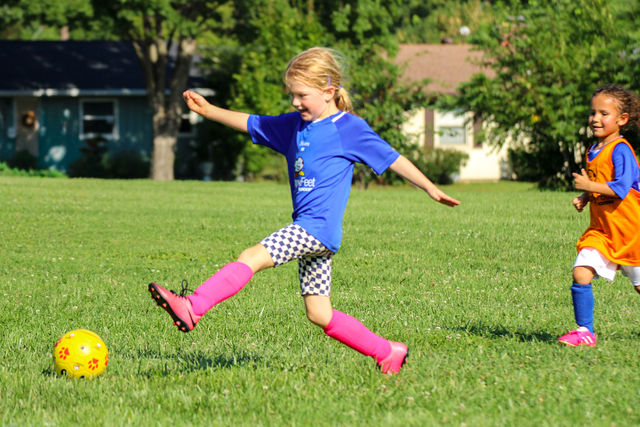
Happy Feet Kansas City serves many Prairie Village families at our Overland Park location. Our classes are built around constant, joyful movement — running, hopping, following Bob the Ball through an imaginative story, and releasing the kind of big energy that toddlers naturally have. Our coaches are trained to recognize when a child is becoming dysregulated and to offer a movement-based reset rather than a time-out or reprimand. For the child who needs to move to feel better, our program is a natural fit. Come try a free class and see how movement transforms big feelings.
Give your child a place where big feelings are welcome and movement is the answer.